

A brief history: deck ventilation
In 1929 Olin Stephens designed the legendary 52 foot yawl Dorade. While she won many races, her most famous feature was the dorade, a novel ventilation system for heavy weather: even with water covering the deck, it would only allow air below-deck.
In the late 1990s the extreme French sailor Guy Delage adapted the concept to fit over a deck hatch (capot). Guy Delage went sailing and passed the concept to Etienne Giroire. Etienne improved the design and this was the beginning of the ATN Dorcap. Dor(ade) + cap(ot).
 Dorade Box Diagram by Aaronx via Wikimedia Commons / CC BY-SA
Two settings, one piece of canvas, no compromises
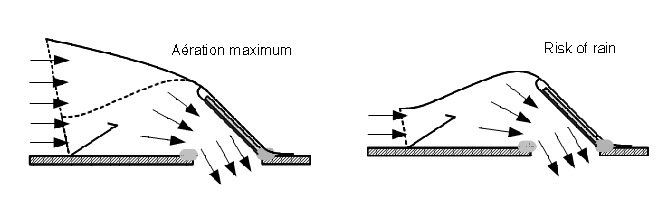
The Dorcap has two operating positions. The maximum airflow position pulls air through the dorade-style intake and directs it into your hatch. The result doubles the airflow of an open hatch. At risk of rain, you simply lower the front edge with the provided straps, which raises the inner dam, blocking the water while allowing the airflow of an open hatch.
All this can be operated from inside or outside the boat on both the Medium and Large sizes. You do not have to leave your bunk when a squall rolls through at 0300.
Why a Dorcap beats a wind scoop
A wind scoop puts a funnel of cloth above your hatch and depends on a steady wind from one direction. When the rain comes, the wind scoop comes down. When the wind clocks, the wind scoop has to be re-rigged. The Dorcap stays on the hatch, ventilating your cabin. The Practical Sailor team field-tested the Dorcap in a 25-knot Florida Keys squall and reported it shrugged the squall off (read the Practical Sailor review).
For maximum at-anchor airflow, the Dorcap pairs naturally with the ATN AirScoop, which mounts on a vertical port window to pull additional air through the cabin. The AirScoop is an at-anchor accessory, not an underway product; together with the Dorcap on a hatch it builds a two-source ventilation path that turns even a hot still anchorage into a comfortable cabin.
Lower your air conditioning load, lower your power draw
Boats spend more battery and generator hours running air conditioning than running anything else. The Dorcap is the single most effective passive intervention against that load. In a Florida or Caribbean anchorage, a Dorcap on the forehatch and a second on an aft cabin hatch can replace four to eight hours of overnight AC use with naturally driven airflow. Pair the Dorcap with the ATN AirScoop on a vertical port window for two intake paths working at the same time.
For the strongest passive-cooling stack, pair the ventilation with the ATN Forward Awning. The Forward Awning drops the cabintop heat load before the air conditioning has to fight it. Sun on a closed cabintop heats the interior all day; an awning intercepts that heat outside the boat. Forward Awning over the cabintop plus Dorcap on the hatch can take an AC duty cycle from "running most of the time" to "running only when you actually need it," with the corresponding drop in battery draw, generator hours, and fuel burn.
How it ventilates (compression acceleration)
The intake hood faces the wind. The hoop-supported rigid structure routes the airstream through a single channel with no lateral leakage. Because the cross-section narrows at the hatch opening, the air accelerates as it enters the cabin. The label "compression acceleration" describes this Venturi-like effect, and the measured outcome is double the airflow you would get with the hatch open and no hood.
Important: To get the full benefit, leave a hatch or a door open on the other end of the cabin so the air has an exit. Ventilation needs both an intake and a path out.
Materials and build
| Fabric: Top Notch 9 | A marine-grade polyester canvas that has proven quite durable in the field. Top Notch 9 holds shape under sustained tropical UV (it is sewn with PTFE thread), resists chafe at the hoop contact points, and recovers cleanly from repeated rain and salt cycles |
|---|---|
| Structure | Delrin rod hoops shape the intake; no extra rigging hardware is required on the canvas itself |
| Attachment | Two footmen at the forward corners, plus a buckle-and-clip assembly that lets you narrow the dorade opening from inside or outside the cabin |
| Storage | Folds flat. Lives in its own stowable bag (stows easily under a bunk) |
| Warranty | 4-year pro-rated warranty. Most customers get 7+years. |
What does it take to complete initial installation?
A first-time install takes 10 to 15 minutes on most boats and uses only the hardware ATN ships in the box. The two pieces of permanent hardware are a pair of footmen and a small set of snap clips that anchor the four corners. The footmen and snap clips are placed slightly outside the perimeter of the hatch so the Dorcap clears the hatch edge when the hatch is fully open. Each piece can be installed two ways:
| Mechanical | Screwed down through the deck or coachroof, standard for owners who want a permanent installation and have no concern about adding fastener holes, we recommend a dab of 5200 or equivalent when installing screws. |
|---|---|
| Adhesive | Bonded with a marine adhesive pad supplied in the kit, no holes in the deck, standard for charter boats, leased boats, and owners who want a reversible install |
The complete installation kit (footmen, snap clips, screws, adhesive pads, and instructions) ships with every Dorcap. The only tools a typical install needs are a drill (if screwing down), a screwdriver, and a clean cloth for the adhesive prep. Once the footmen and snap clips are placed, the Dorcap drops onto the hatch back pocket and clips up in seconds; subsequent removals and reinstallations take under a minute.
Hatch compatibility
The Medium covers hatch openings up to 20 inches wide. The Large covers openings up to 24 inches wide. Common brand fits at those sizes:
| Hatch brand and series | Common opening | Dorcap size |
|---|---|---|
| Lewmar Ocean (Size 50, 60) | ~17 to 22 in | Medium or Large |
| Lewmar Atlantic | up to 24 in | Large |
| Bomar (N-series, 2000-series) | varies | Medium or Large |
| Goiot Cristal | ~20 to 23 in | Large |
| Vetus Magnus | up to 24 in | Large |
Measure the long dimension of your hatch opening (not the frame), then select the next size up. The Dorcap fits hatches that open toward the bow, toward the stern, or athwartships, with only the deck-side attachment routine changing between orientations. If your hatch is not on this list, send us your hatch measurements and we will confirm fit before you order.
Pricing
Two stocked colors ship within a few days. Nine custom colors add 10 percent and ship in three to four weeks.
Stocked colors (ships in days)
Medium, stocked
Fits hatch openings up to 20 inches wide. Admiral Navy or Silver Gray.
$535.00
Large, stocked
Fits hatch openings up to 24 inches wide. Admiral Navy or Silver Gray.
$585.00
Custom colors (+10 percent, ships in 3 to 4 weeks)
Medium, custom color
Fits hatch openings up to 20 inches wide. Choose from nine custom colors.
$588.50
Large, custom color
Fits hatch openings up to 24 inches wide. Choose from nine custom colors.
$643.50
Color choices
Stocked (ships in days): Admiral Navy, Silver Gray.
Custom (+10 percent, ships in 3 to 4 weeks): Caribbean Blue, Forest Green, Tan, Taupe, Cardinal Red, Burgundy Weave, Charcoal, Black, White.


Where the Dorcap is at home
- Caribbean, Bahamas, Florida, and Gulf liveaboards at anchor.
- Pacific cruisers in trade-wind anchorages.
- Anywhere on the tropical belt of our blue planet.
- Catamaran owners with multiple forward cabin hatches: two Dorcaps on the forward hatches create cross-flow that ventilates both cabins without leaving either cabin hostage to weather.
- Charter fleet managers outfitting boats for guests who do not want to wake up wet.
Honest answers to common concerns
Can I take it down fast when a storm comes through?
Four corner footmen and the buckle-and-clip assembly come off in under five minutes. For passages and named storms, the Dorcap goes in its bag. The Dorcap is designed to ride out up to 35-knot squalls; beyond that you will want to consider bringing it down.
Is this just a fancy wind scoop?
While both can improve air flow, they are very different in form and function. The wind scoop requires a halyard and is worse than useless in a squall (unless you want to funnel water into your cabin). The Dorcap is a hoop-stabilized, rigid-shaped boat hatch ventilator that stays on the hatch in a squall.
Will it actually keep rain out?
Yes, in the "rain risk" position. The Practical Sailor 25-knot Florida Keys field test backs that up (see the Press section below). The Dorcap is not a closed hatch; if a hurricane band squall sustains 50 knots of horizontal rain, close the hatch. For everyday tropical squalls, the Dorcap lets you keep ventilating without getting soaked.
Does it work if the wind shifts?
The Dorcap performs best with the intake pointing into the prevailing wind. Daniel Wade at Life of Sailing notes in his balanced review that the Dorcap is not omnidirectional and is not designed to be repositioned if the wind direction changes while you are at a dock. For anchorages where the wind clocks, the boat will follow the wind to remain facing into it.
Press and Reviews
Latitudes & Attitudes magazine
Latitudes & Attitudes magazine ran a full Dorcap product review on page 98 of their Spring 2012 issue. The review is hosted on the ATN site as a PDF reprint.
Read the Latitudes & Attitudes Dorcap review (PDF)Etienne Giroire is a world renowned sailor who has created a bunch of products to make sailors' lives easier. His company, ATN Products (yes, Etienne is pronounced ATN) has come up with the perfect answer to get air below decks when you are in the hot tropical climates.
Latitudes & Attitudes magazine, page 98, Spring 2012 (read the full PDF review)
Its ideal design, rigid system, absence of lateral leakage, provide a "compression acceleration" air stream which penetrates to the interior of your vessel. This doubles the airflow of an open hatch.
Sail World Cruising staff (read on Sail World Cruising)
Here's a unique all-weather wind scoop designed to hold up to rain, wind, and spray. The ATN Dorcap wind scoop is self-supported and fits most standard boat hatches. Despite its small size and air dam, it moves a remarkable amount of air through the cabin. It can be operated from inside the cabin as well.
Daniel Wade, Life of Sailing (read on Life of Sailing)