Press clipping · SAIL Magazine
Using Storm Sails: SAIL Magazine on storm canvas and the ATN Gale Sail
Sailmaker and Whitbread Race veteran Brian Hancock wrote this feature for SAIL Magazine. His question is a simple one: do you actually need storm sails, and how should your boat carry them? For answers he turned to two of the most respected sailmakers in America, Dave Ullman of Ullman Sails and Chris Howes of Doyle Sails.
For the most common rig afloat, a sloop with a roller-furling genoa and no inner forestay, the sail they land on is the ATN Gale Sail.
“Typically, storm sails are buried in the depths of a locker or under a bunk… This is a mistake: nothing is more important than the safety of the boat and crew. So when you're on passage, your storm sails need to be easy to locate and ready to use.”
Brian Hancock, “Storm Sails: Do You Need Them?” SAIL Magazine. Read on SAIL Magazine

What the article says
Practice before you need them
Most offshore sailors carry a storm jib and a trysail. Very few have ever hoisted them. The article's first piece of advice costs nothing: set your storm sails at the dock. Pre-measure the tack strops. Mark the sheeting positions. Stow the sails where you can reach them, not under a bunk. Done properly they trim right the moment they go up… because if they go up you are likely in need of them quickly.
Three boats, three storm setups
The article looks at three hypothetical but representative boats, and we add a note on multihulls:
- 36-foot family cruiser
furling genoa, no inner forestay. A partly rolled genoa is not a storm sail, and nobody wants to wrestle a furled headsail open as a gale builds. This is the boat the Gale Sail was designed for.
- 50-foot bluewater cruiser
a permanent inner forestay carries a hanked-on storm jib. A dedicated track lets the trysail live at the mast, bagged and ready to hoist.
- 45-foot ocean racer
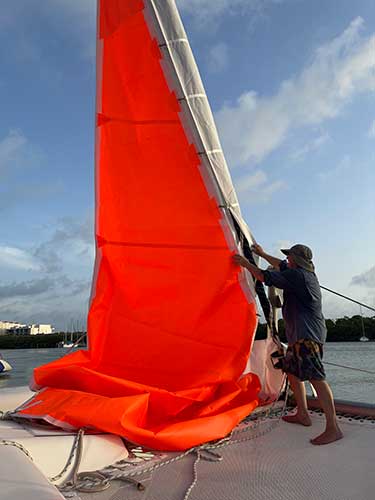
no trysail aboard. Instead, a very deep third reef in the main and a removable aramid inner stay flying a bright orange storm jib on soft webbing hanks.
- Multihull
depends on the rigging. If it has an inner forestay, a dedicated storm jib can work well. If not, the Gale Sail wrapped around the furled headsail is likely the best option.
Where the Gale Sail fits
The ATN Gale Sail is a purpose-built storm jib. Its sleeve wraps around the furled headsail and closes with large piston hanks, sized to be worked with cold fingers. It hoists right over the furled sail on a spare halyard, the same over-the-furled-sail principle behind our Genoa Sleeve. With the tack strop pre-measured, the sheeting position is right the moment the sail is up.
The honest fine print
The article does not oversell the Gale Sail, and neither do we. Because it sets on the forestay rather than an inner stay, the center of effort sits a bit farther forward than ideal, and the bow is a livelier place to work than the mast. However, for the very many boats that do not have an inner stay they can dedicate to a storm jib, the ATN Gale Sail is an excellent solution for the problem at hand… sailing in adverse, high-wind conditions. Skipper David Linger reached the same verdict in his Global Solo Challenge Gale Sail review.
The trysail debate
Howes says a serious passagemaker wants both a deep third reef and a trysail. Ullman goes further: never go offshore without one. Both agree the right setup depends on the age and agility of the crew who have to wrestle the sail onto a heaving foredeck.
What SAIL Magazine says about the Gale Sail
“As the sail is hoisted the Dacron sleeve slides over the Dacron fabric of the sail on the headstay with surprisingly little friction.”
“Using Storm Sails,” by Brian Hancock, SAIL Magazine. Read on SAIL Magazine
“Once hoisted there is very little chafe as there is no point-loading anywhere along the luff of the sail.”
“Using Storm Sails,” by Brian Hancock, SAIL Magazine. Read on SAIL Magazine
Short excerpts reproduced under fair use for review purposes. The full article lives in the scanned clipping below.
Read the full article
The scanned clipping below is the complete print article, about 1,800 words: all three boat scenarios, the dock-rehearsal method, and the trysail debate.
View the original clipping (PDF)
Prefer to read it online? SAIL Magazine publishes a shorter edit: Storm Sails: Do You Need Them? The full text is also preserved in the Internet Archive's copy of the author's site.
The storm nobody forecasts
The gales in this article are the forecast kind, the ones you rig for at the dock. The other kind arrives at night in ten minutes. In the 2010 Route du Rhum, ATN founder Etienne Giroire, whose 1992 OSTAR record still stands, was capsized by a 30 knot night squall 1,300 miles from Guadeloupe, with two reefs already tucked in. The chart below maps his race, reconstructed from his own words. Read Etienne's full Route du Rhum story.

The storm jib for roller-furling headsails
If you have a sailboat without an inner stay that you can use to hoist a storm jib, the ATN Gale Sail is the storm jib built for you.
Not sure what size fits your boat? Talk to ATN about storm sail sizing.